

Why there's no list price
Flock Safety doesn't post prices. Its pricing page says the cost depends on "your coverage area, sensor types, and software package" and asks you to request a quote. The real numbers are in city council and county board agendas. Many police contracts go to a public vote, and signed contracts are generally public records even when they don't.
Those contracts line up fairly well. A standard Flock license plate camera (the Falcon) runs about $2,500 to $3,000 a year, with a small one-time installation or implementation charge in some contracts. In the contracts below, the two biggest buyers pay about $2,500, and most smaller cities pay $3,000 or more.
You don't buy the camera. Flock sells an annual subscription that bundles the hardware, installation, maintenance, LTE cellular data and cloud storage, and the pricing page says Flock removes the hardware if a customer doesn't renew. So a camera that's been up for five years has cost five annual fees, not one purchase.
What cities actually pay
The per-camera figures below are our arithmetic from each published total. They're rough: some totals include software or service that isn't the camera itself.
| Place | Cameras | Yearly cost | Per camera, per year | Source |
|---|---|---|---|---|
| Riverside County Sheriff, CA | 538 | $1,350,000 (renewal years) | about $2,500 | Board of Supervisors item |
| Cleveland, OH | about 100 | $125,000 for a six-month extension, including software and maintenance | about $2,500 (annualized) | GovTech |
| Shaker Heights, OH | 11 added in 2025 | $33,000 ($37,150 in year one, with installation) | $3,000 | GovTech |
| West Fargo, ND | 30 | $90,000 from year two | $3,000 | Valley News Live |
| Morrow, OH | not stated | not stated | $3,000, per the mayor | Council minutes, July 2026 |
| Fort Wayne, IN | 36 | $120,000 (proposed one-year renewal) | about $3,330 | 21Alive |
| Strongsville, OH | 19 | $63,500, plus $8,750 one-time | about $3,340 | GovTech |
| Sterling Heights, MI | 23 | about $84,100 (estimate) | about $3,660 | WXYZ |
Morrow is the one that shows the price can decide a vote. In July 2026 its mayor said the cost, $3,000 a year apiece, wasn't justified when the cameras had produced only a couple of notifications. Council voted to remove them that night. Our list of cities that cancelled Flock has others where cost was a stated reason.
Costs on top of the camera fee
The per-camera fee often isn't the whole bill. Watch for these in a contract:
- Implementation or installation. Strongsville paid $8,750 once on top of its first year. Shaker Heights folded installation into a higher first-year price.
- Other Flock products. Many contracts bundle more than plate readers. Fargo spent $33,000 in 2025 on video integration hardware and software, with $32,300 a year to follow. Smyrna, Georgia, approved $5.7 million over 10 years for 70 devices, two of them drones.
- Leaving early. Lynchburg, Virginia, would have owed $500 per device, about $34,500, to take its plate readers and gunshot sensors down before April 2027. Council chose to keep them offline and remove them when the contract runs out (WSET).
- Price changes at renewal. Oberlin, Ohio, said it was ending its contract over "an increase in pricing" (Jalopnik, citing the Oberlin Review). Compare a renewal's order form with the old one rather than assuming the rate carries over.
Who pays for Flock cameras
Public cameras come out of a police or city budget, and grants often cover part of the bill. Fargo and West Fargo used a federal Project Safe Neighborhoods grant for part of their 2025 spending. In Texas, a state authority put at least $30 million into local Flock networks through grants funded by a $1 fee on auto insurance policies, until Gov. Greg Abbott ordered state agencies to stop funding Flock cameras in August 2026 (Texas Tribune).
Not every Flock camera is public money. Stores, shopping centers and homeowners associations buy their own, and those cameras don't appear in any city budget. Our guide to plate readers at stores covers the biggest private operators.
How to find what your city pays
- Search your city council or county board agendas for "Flock". Contracts and renewals are usually approved as agenda items with the staff report and order form attached.
- If the agenda doesn't include the order form, ask for it with a public records request. Ask for the current contract, every order form and amendment, and the invoices for the last two years.
- Divide the recurring yearly total by the number of cameras, and check what else the total includes before comparing it with the table above.
Estimating a city's spend from the map
A rough check is the number of cameras the city itself runs times $2,500 to $3,000. The hard part is the count, because a city's limits also hold cameras run by the county, stores and HOAs, and only the police department's own count toward its contract.
Flock Camera's map shows the recorded operator when you tap a camera, and Area Stats lists the top operators for whatever part of the map is on screen. Zoom to your city and you have a starting point for which mapped cameras are the police department's and which belong to someone else. The location pages give each place's mapped total, and the web map shows the pins in a browser.
Treat the result as an estimate: the map is crowdsourced, not every camera has an operator recorded, and some cameras haven't been mapped yet. The contract is the real number.
Frequently asked questions
How much does a Flock camera cost per year?
Public contracts put a standard Flock license plate camera at roughly $2,500 to $3,700 a year. Riverside County's sheriff, with 538 cameras, works out to about $2,500 each. Shaker Heights, Ohio, pays $3,000, and Sterling Heights, Michigan, works out to about $3,650.
Can you buy a Flock camera outright?
Not in the usual way. Flock sells an annual subscription that bundles the camera, installation, maintenance, cellular data and storage. Its pricing page says that if a customer doesn't renew, Flock removes the hardware.
Who pays for Flock cameras?
Usually the city or county police budget, often helped by grants. Fargo used a federal Project Safe Neighborhoods grant, and Texas put at least $30 million in state grants into Flock cameras before the governor halted state funding in August 2026. Stores and HOAs pay for their own.
Can an HOA buy Flock cameras?
Yes. Flock sells to homeowners associations and businesses as well as police, and those cameras are paid for privately. Flock doesn't publish HOA prices. In 2025, Firestone, Colorado, police asked HOAs to cover a $4,500 yearly fee, which one resident worked out at $13 per household.
Does it cost money to cancel a Flock contract?
It can. Lynchburg, Virginia, would have owed $500 per device to take its cameras and gunshot sensors down before the contract ended in April 2027, about $34,500 in total. Its council chose to keep them offline and remove them when the contract ends.
Know before you pass one.
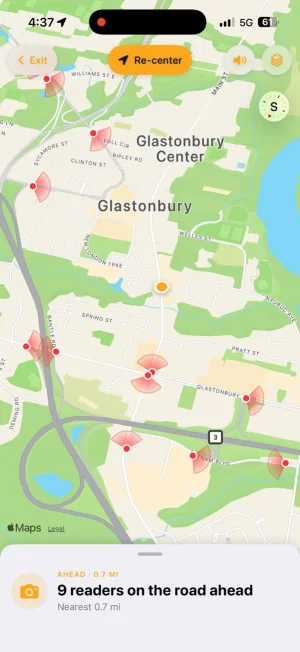
Flock Camera draws a view cone on every camera with a recorded bearing and warns you before you pass one. Free, with no account.

 Scan with your iPhone
Last reviewed 2026-10-26. Camera data © OpenStreetMap contributors (ODbL). Flock Camera is an independent project and is not affiliated with or endorsed by Flock Safety, Inc.