
Captured and searched are two different records
"Was I flocked?" can mean two things, and they live in different places. Captured means a camera photographed your car as you drove past. Searched means someone typed your plate into Flock's system later and looked for those photos. You can be captured hundreds of times and never searched. And a search can come back with nothing, if the car never drove past a camera that agency can see.
| Captured | Searched | |
|---|---|---|
| What happened | Your car drove through a camera's field of view | An operator queried your plate in Flock |
| Where it's recorded | The camera's reads (image, plate, time, location) | The agency's audit log |
| How long it lasts | Days or weeks. Flock's default dropped to 7 days in August 2026 | Set separately. Virginia allows up to 2 years |
| Can you see it? | Rarely. Agencies seldom release reads | Sometimes, through public records |
Searches are the half you can actually check. Logs can outlive the photos by a long way (Virginia deletes reads after 21 days but keeps the audit trail for up to two years), and many agencies release them. The photos usually expire before anyone thinks to ask. How long Flock keeps data has the retention details.
How to check if your plate was searched
- Look it up on HaveIBeenFlocked. Enter your plate at haveibeenflocked.com. The nonprofit site says it covers "the 243,098,172 Flock searches we know about," all from audit logs that agencies released under public records laws. It says it doesn't store the plates you enter.
- Read the hit. Each result is a row from an audit log: the agency, when the search ran, the stated reason and, where recorded, a case number. The reason field ("stolen vehicle", "investigation", a bare case code) tells you more than anything else on the page.
- Find the agency that runs your local cameras. If you got no hit, the cameras you drive past may belong to an agency whose logs were never released. Look them up on the map or your town's page and note the operator. It's often a sheriff or a neighboring city.
- Request that agency's Organization Audit. Ask for the log of searches by its own users, as a CSV, for a date range, and say you're looking for searches of a specific plate. This log shows the plate in full. The public records request guide has a template you can adapt.
- Ask for the Network Audit too. It lists searches of that agency's cameras by other agencies. Per HaveIBeenFlocked's field guide, operator names and plates in it are usually redacted with asterisks, so you'll see that outsiders searched but not always for whom.
What a hit means, and what a blank means
A hit is a fact about a query. HaveIBeenFlocked's own wording is careful: the person who searched "is not necessarily a police officer, and a search does not imply you were stopped or investigated." It also doesn't tell you whether the search returned any photos. Plates turn up in logs for stolen-vehicle checks, open investigations and, in documented cases, officers looking up people for personal reasons. The reason field is your best clue to which.
A blank means much less. The site calls its dataset "incomplete; few governments provide easy access to these logs." No result usually means the agency that searched hasn't released its logs, not that nobody searched.
Where you can't get the logs
State law decides this. In Virginia, Va. Code § 2.2-5517 requires an audit trail of every query (purpose, case number, username), deleted after two years, then exempts it from the state's FOIA. You can't request it; it comes out mainly in criminal discovery or under a court order.
Washington went the other way on audits. SB 6002 shields plate reader data itself, but a municipal law analysis concludes audit trail records (who used the system, and when) are still disclosable, with unique identifiers partly redacted. Most states fall somewhere between, and fees vary wildly. One Texas city quoted about $2.3 million for a broad request, which is why asking for audit exports rather than emails matters.
Audit logs got more useful in August 2026
On August 13, 2026, Flock announced that police searches must carry a case number or code, with emergency exceptions flagged for review. Its AI "Audit Assistance" tool, which flags possible misuse, became mandatory for police customers, and flagged users can be locked out until an administrator reviews them. For you, that means newer log entries should carry a case code, which gives a follow-up records request something specific to name. Entries from before that date may not have one.
Who can access Flock data explains which agencies can search a given camera in the first place.
Checking the "captured" half with the app
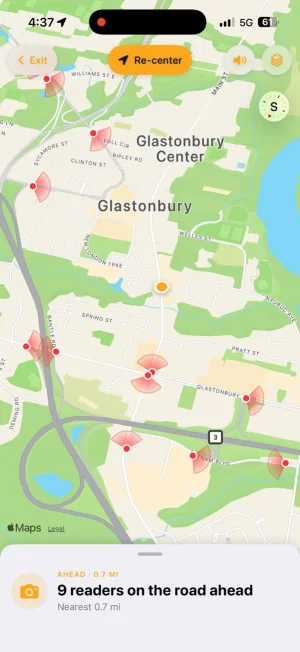
No public tool tells you which cameras photographed your car. Flock Camera gives you an estimate of your own. With alerts on, it logs every mapped plate reader you pass, with the street and town, and marks an encounter "likely captured" when you were close enough and in front of the lens.
That's a geometric estimate from community-mapped positions and facing directions, not a confirmation. The app has no access to Flock's systems and can't tell you whether your plate was read or searched. Did a Flock camera photograph my car? explains the geometry.
The map is where it helps with the search half. It covers 143,415 mapped plate readers in the US, Flock's and other brands'. Tap a camera to see its operator where one is recorded, or open Area Stats for the top operators on screen. That tells you which agency's audit log to ask for. Your History stays on the phone; your location is never transmitted.
Frequently asked questions
Can I find out if Flock searched my plate?
Sometimes. HaveIBeenFlocked.com covers searches from agencies whose audit logs have been made public. For anywhere else, request the Organization Audit from the agency that runs the cameras. Some states, Virginia among them, exempt audit data from public records laws.
Does HaveIBeenFlocked show if I passed a camera?
No. It only shows searches, meaning someone typed your plate into Flock's system. It has no record of which cameras your car drove past, and the site says so plainly.
What is a Flock audit log?
A record of every search run on an agency's Flock account: the time, the plate or text searched, the stated reason, the case number and how many cameras were searched. Agencies can export it as a spreadsheet.
Does a search mean I'm under investigation?
Not necessarily. A search means an operator queried your plate. It doesn't show that you were stopped, suspected of anything, or that the search returned a photo of your car. The stated reason field is the best clue.
Will Flock tell me if my plate was searched?
No. Flock Safety doesn't notify drivers, and public records laws apply to the agencies that buy the cameras, not to Flock. The agency's audit log is the record to ask for.
Know before you pass one.
Flock Camera draws a view cone on every camera with a recorded bearing and warns you before you pass one. Free, with no account.

 Scan with your iPhone
Last reviewed 2026-10-12. Camera data © OpenStreetMap contributors (ODbL). Flock Camera is an independent project and is not affiliated with or endorsed by Flock Safety, Inc.