
What a Flock transparency portal is
A transparency portal is a public web page about one agency's Flock cameras. Flock Safety builds it from the agency's own account, so the usage numbers come straight from the system rather than from a press release. Flock says the first went live in 2021 for police in Piedmont, California, and that the portal would be offered to all of its law enforcement customers.
The key word is "offer." Each agency decides whether to turn its portal on and what to put on it. Flock's own description says a portal "can include policy information, usage statistics, and sharing details," plus a public search audit showing fields such as case number, search reason and offense type. Can, not must. Two portals from agencies a few miles apart can look very different.
That's why a portal is a good first stop but rarely the last one. It tells you an agency has Flock cameras and roughly how hard it uses them. It won't show whether your plate was searched, and it doesn't list where the cameras are.
What's on a portal, and what's often missing
Here's what agencies have actually published, based on local reporting from 2026:
| Field | Example |
|---|---|
| Number of cameras | Kent County, Michigan, sheriff lists 62 |
| ALPR policy and retention period | Grand Rapids keeps 30 days and says so |
| Vehicles detected, searches and hotlist hits (last 30 days) | Hickory, North Carolina: 387,506 plates, 76 searches |
| Agencies the data is shared with | Albany, Oregon, listed 21 Oregon agencies |
| Search audit (time, reason, case number) | Fargo, Grand Rapids |
Sources: Spectrum News (Kent County, Grand Rapids), WBTV (Hickory), Hasso Hering (Albany) and Valley News Live (Fargo).
The gaps are where critics focus. In Rhode Island, the ACLU of Rhode Island found in August 2026 that eight departments with portals didn't list who they share data with, and that only two published search audits, Newport's among them. It also reported that Newport's portal once listed hundreds of agencies with access, and that the list was later removed. In Albany, six of 14 listed searches gave no reason.
How to find yours
- Work out who runs the cameras. The portal belongs to the agency that bought the cameras, and that isn't always your city. A county sheriff, a neighboring town or a private owner like a store may run the ones you drive past. Start with the cameras on the map or your town's page.
- Search the agency's name. Try "[agency name] Flock transparency portal." Local news often covers a launch, and many cities link the portal from a police department page titled "Flock" or "ALPR." The ACLU of Rhode Island reported that portal links dropped out of Google's first page of results in May 2026, so the agency's own site may be more reliable than a search.
- Try the address directly. Portals live at
transparency.flocksafety.com followed by a short name for the agency, such as
piedmont-ca-pdorkent-county-mi-so. The pattern isn't fixed (Milwaukee's ismilwaukee-wi-pd-, with a trailing dash), so a miss doesn't prove there's no portal. - Ask. If you can't find one, email the department or its records officer and ask whether it has a portal. If it doesn't, the same information is available through a public records request, usually in more detail.
Why many agencies don't have one
Portals are optional, and most agencies haven't switched them on. A Texas Tribune review published in October 2026 looked at hundreds of Texas agencies using Flock and found that only 59 use transparency portals. Those portals cover about a fifth of the cameras the Tribune estimates are operating in the state. Of those 59, only 16 share their search records.
The ones that exist often came with a push. Chatham County, Georgia, police launched theirs in July 2026 after officers elsewhere in Georgia were fired and arrested over Flock misuse, WRDW reported. Antioch, California, police tied theirs to a transparency agreement with the US Department of Justice. A portal is something an agency chose to publish, so it can also be trimmed later.
When the portal isn't enough
A portal answers "does this agency use Flock, and how much?" It doesn't answer "was my plate searched?" The public audit fields Flock describes (case number, reason, offense type) don't include the plate, so you'll need the agency's full Organization Audit for that. Our guide to finding out if your plate was searched covers HaveIBeenFlocked and the records route.
Sharing works the same way. If the portal's sharing list is blank or missing, ask for the agency's network sharing list in a records request. Who can access Flock data explains what that list means.
Finding the right agency with Flock Camera
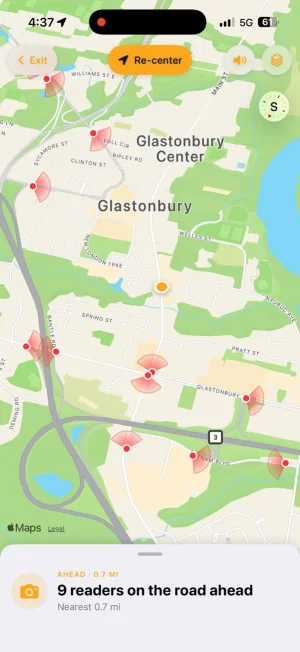
Step one is often the hardest: knowing whose cameras you're looking at. Flock Camera maps 143,415 plate readers in the US, Flock Safety's and every other brand's. Tap a camera to see its operator where one is recorded, along with its brand and facing direction. Area Stats lists the top operators for whatever part of the map is on screen, so you can see whether your area is covered by the city, the county or a store before you go looking for a portal.
The app doesn't connect to Flock's systems or to any portal. It can't show search counts, and it can't tell you whether your plate was read. Camera positions come from OpenStreetMap and are community-reported, so an operator can be missing or out of date. If a portal lists more cameras than you can find nearby, anyone can add the missing ones on OpenStreetMap.
Frequently asked questions
How do I find my city's Flock transparency portal?
Work out which agency runs the cameras near you, then search for its name plus "Flock transparency portal" and check its website for a Flock or ALPR page. Portals are hosted on transparency.flocksafety.com, one page per agency. If nothing turns up, ask the agency's records office.
What does a Flock transparency portal show?
It varies by agency. Typical fields are the number of cameras, the ALPR policy, the retention period and 30-day totals for vehicles detected, searches and hotlist hits. Some add the agencies they share data with and a search audit with reasons and case numbers. Many leave those last two out.
Why doesn't my city have a Flock transparency portal?
Agencies choose whether to publish one, and many haven't. A Texas Tribune review in October 2026 found 59 Texas agencies using portals out of hundreds that use Flock. Your city may also not run the cameras near you: a county sheriff or a store might.
Does a transparency portal show if my plate was searched?
Not by plate. Where a portal publishes a search audit, it lists searches with times and reasons but no plate numbers. To check a specific plate, use the agency's full audit log through a public records request.
Does a Flock transparency portal show camera locations?
Usually not. Portals give a camera count, not a map. Most mapped positions are public anyway through OpenStreetMap, and the map on this site shows them.
Know before you pass one.
Flock Camera draws a view cone on every camera with a recorded bearing and warns you before you pass one. Free, with no account.

 Scan with your iPhone
Last reviewed 2026-10-28. Camera data © OpenStreetMap contributors (ODbL). Flock Camera is an independent project and is not affiliated with or endorsed by Flock Safety, Inc.