

About 75 feet, in a narrow slice of road
Flock Safety doesn't publish a spec sheet, but its public FAQ gives the numbers that matter. "Our motion detection works up to 75 feet, and the field of view at that distance is ~20 feet wide," it says. Elsewhere on the same page: "Flock Safety is able to capture vehicles traveling up to 100 MPH, day and night, and up to 75 ft away."
Put those two figures together and you get a skinny wedge. Twenty feet across at 75 feet out works out to an angle of roughly 15 degrees, which is our arithmetic and not a Flock figure. Flock calls the view "intentionally narrow" and says one camera "is designed to capture 1.5 lanes of traffic, heading in a single direction."
Treat 75 feet as the outer edge of where the camera starts capturing, not a promise that every plate is legible there. A clean read also depends on the angle, the weather, dirt on the plate and how the camera was installed. Each vehicle gets a burst of "somewhere in the range of 6-12 images," per the FAQ, which gives the software several chances to read it.
Why direction beats distance
A plate reader isn't a dome watching everything around it. It's a fixed lens aimed down one approach of one road. That has a few consequences people don't expect:
- You can pass right under the pole and stay out of the frame if you're driving away from the lens.
- The opposite direction of a two-way road usually needs its own camera. Flock says it "never recommend[s] shooting across lanes of traffic."
- On roads wider than 70 feet, Flock's FAQ warns that a single camera may miss vehicles, so busy entrances often carry two or three.
So "how far" is only half the question. The other half is "which way is it pointing?" Whether a Flock camera photographed your car walks through that geometry for a single pass.
Range by device
| Device | Stated range | Coverage | Source |
|---|---|---|---|
| Standard fixed plate reader | Up to 75 ft (about 23 m) | ~20 ft wide, about 1.5 lanes, one direction | Flock FAQ |
| Long-Range LPR | Not published | "High-speed, multi-lane, and off-shoulder roadways" | Flock product page |
| Wide-Range LPR | Not published | "Wider field of view for broad roadway coverage" | Flock product page |
| Alpha drone | Up to 2,000 ft | Aerial, not a fixed camera | Flock Alpha page |
The 75-foot figure covers the familiar solar-panel pole camera. Flock now sells long-range and wide-range models without publishing their distances, so a reader on a highway shoulder may reach farther than one at a subdivision gate. The 2,000-foot drone number is a marketing claim for a very different product. What a Flock camera looks like covers how to tell the hardware apart.
Night, infrared and the missing flash
The readers work after dark. Flock's FAQ says "the infrared technology that we use to capture license plates illuminates reflective subject matter," and that "anything that is not reflective (license plate) or illuminated (light pattern of the vehicle) will be completely dark." In other words, the plate pops out and most of the scene disappears.
Infrared is light the eye mostly can't see, so there's no bright flash like a red-light camera's. If you're looking for a visible pop to tell you a reader just caught you, you won't reliably get one. Flock also says its cameras don't detect speed; the comparison with speed cameras explains what each one records.
Seeing the field of view on a map
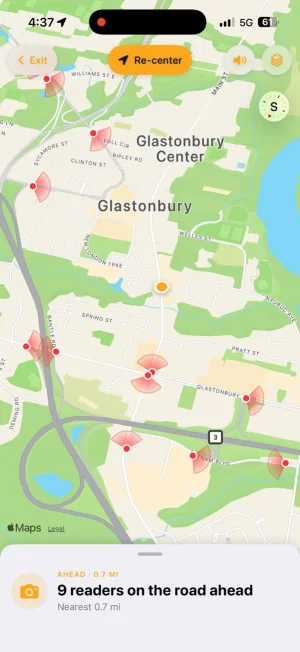
Because the capture zone is a narrow cone pointing one way, a dot on a map only tells you part of the story. Flock Camera draws a view cone for each camera with a known facing direction. That's 136,653 of the 143,415 mapped US readers, about 95%. Tap a camera for its brand, operator, facing direction and mount.
The alerts follow the same split between distance and direction. You set a warning distance from 200 m to 1.5 km, well beyond the camera's own 75-foot reach, so the first alert is a heads-up that a mapped reader is ahead. A second, separate alert fires when you enter the camera's field of view.
In History, an encounter is marked "likely captured" only when you were close enough and in front of the lens. That's a geometric estimate from community-mapped positions and directions, not a confirmation from Flock, and coverage varies by area.
The map on this site shows where readers are mapped along any road; the view cones are in the app. If a camera near you is missing or has no direction, you can add it on OpenStreetMap. For what happens to the images once they're taken, see how Flock cameras work.
Frequently asked questions
How many lanes does one Flock camera cover?
Flock's FAQ says one license plate camera is designed to capture about 1.5 lanes of traffic heading in a single direction. That's why wider roads and entrances often get two or more cameras, and why Flock advises against aiming across lanes.
Do Flock cameras work at night?
Yes. Flock says its readers capture vehicles day and night. They use infrared light, which makes the reflective plate stand out. Flock's FAQ notes that anything that isn't reflective or lit, such as the area around the car, comes out completely dark.
Does a Flock camera flash?
Not in the way a speed camera does. Flock describes infrared illumination, which the human eye mostly can't see, so you usually won't notice anything when a reader captures your car. Don't count on a flash to tell you whether one is working.
Can a Flock camera read plates going 100 mph?
Flock says its readers capture vehicles traveling up to 100 mph. They take a burst of roughly 6 to 12 images per vehicle. They don't measure speed, though: Flock says its cameras have no speed detection.
Can Flock drones read plates from farther away?
Flock markets its Alpha drone as reading license plates from up to 2,000 feet. That's a manufacturer claim for a different product. Drones aren't fixed pole cameras, and they aren't on the map of plate readers.
Know before you pass one.
Flock Camera draws a view cone on every camera with a recorded bearing and warns you before you pass one. Free, with no account.

 Scan with your iPhone
Last reviewed 2026-11-09. Camera data © OpenStreetMap contributors (ODbL). Flock Camera is an independent project and is not affiliated with or endorsed by Flock Safety, Inc.