

What the bill would do
Despite the name, the Ban Flock Act doesn't mention Flock Safety. It's about every automatic license plate reader (ALPR), whoever makes it. The bill text has three main parts:
- Federal agencies stop using plate readers. No federal agency, official or anyone acting for one could "acquire, possess, access, or use" a plate reader, or plate data collected by anyone else. That includes a city's cameras, a store's network or a data broker. There are two exceptions: tolling, with reads deleted 48 hours after the toll is paid, and any future use Congress approves in a separate law that also caps retention at 48 hours.
- Grants depend on a local ban. From the first full fiscal year after it passed, state and local governments would lose certain grants from the Departments of Justice, Transportation, Health and Human Services, Housing and Urban Development, and Homeland Security. They'd keep them only by having "a law or binding policy" that bans plate readers for their own agencies at least as strictly as the federal ban.
- No federal money for plate readers. Federal funds couldn't buy, run or upgrade a reader or pay for plate data. Grant money spent that way would have to be paid back.
People harmed by an illegal federal use could sue the government for damages, state attorneys general could sue on residents' behalf, and evidence gathered in violation generally couldn't be used.
What it wouldn't do
It wouldn't make a single camera illegal. Section 5 says plainly that states, cities and other non-federal entities can still use their own money for anything else the act allows. Its only lever on local cameras is federal grant money.
Launch-day coverage mostly missed two points.
- The trigger is a missing ban, not owning cameras. Press releases say grants stop for governments "that use" plate readers. Read literally, the text withholds grants from any government without a matching law or binding policy, including one that's never bought a camera. How agencies would apply that is unknown.
- Private cameras stay, but police access may not. An HOA, a Lowe's lot or a mall could keep its readers. A city that passes a matching ban to protect its grants, though, would have to stop its police using plate data from readers "operated by another entity", which is how police reach private cameras that share with them. Our guide to who owns the camera on your street explains those sharing setups.
How it compares with the other federal Flock bills
At least five plate reader bills were filed in the House this year, according to a November 9 Atlanta News First review of congressional records. These three get the most coverage:
| Ban Flock Act | Flock-Off Act | Stop Flock Abuse Act | |
|---|---|---|---|
| Sponsor | Ocasio-Cortez (House); Sanders, Merkley (Senate) | Rep. Thomas Massie (R), Rep. Eric Burlison (R) | Sen. Josh Hawley (R) |
| Number | H.R. 10691, Oct. 1 | H.R. 10221, Sept. 2 | Announced Sept. 30; we found no bill number |
| Federal agencies | Banned, except tolls or a future act of Congress | Must remove federally funded systems | No ban; rules for how agencies use readers |
| Local police | Lose five departments' grants without a matching ban | Must stop federally funded systems within 180 days | 10-day deletion, written approval for each search, audits |
| Other limits | Right to sue the federal government | Also covers biometric cameras; exempts tolls and cameras within a mile of the border | No facial recognition; no selling data to non-government third parties |
| Status | In committee | In committee | Unclear whether formally filed |
Sources: the bill text above, Burlison's Flock-Off announcement, and The Record and Newsmax on Hawley's bill. We couldn't find a Senate number for the Ban Flock Act or Hawley's bill.
The bills split two ways. The Ban Flock Act and Flock-Off Act would end federally funded plate reading. Hawley's bill keeps the cameras and adds rules, and Flock told The Record it "strongly supports legislation establishing guardrails." The company says its cameras help solve more than a million crimes a year (Newsmax). The ACLU's Chad Marlow told The Record that Hawley's bill doesn't go far enough and only a ban solves the problem.
Will it pass?
Probably not this year. The official status record shows one action: referral to nine House committees on October 1. Two Democrats, Chellie Pingree and Ilhan Omar, signed on as cosponsors on October 6. TechCrunch said it "faces long odds".
The 119th Congress ends in early January 2027, and unpassed bills die with it. Sen. Richard Blumenthal told Atlanta News First there "may be an opportunity in the lame duck, if there's enough consensus." If that doesn't happen, the sponsors would have to start over in 2027. Until a federal law passes, the rules that actually apply come from states, listed in our state-by-state table.
Seeing which cameras the bill would touch
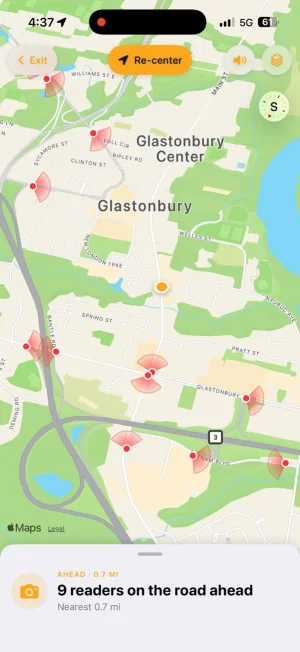
None of these bills would take down the cameras near you right away, and which one could affect a given camera depends on who runs it. Tap a pin in Flock Camera to see its brand and operator, where those are recorded, so you can tell a police camera from an HOA's or a retailer's. Area Stats lists the top operators for whatever's on screen.
The bill covers every brand, and so does the map. Flock Safety pins are red and other brands amber, across more than 143,000 US plate readers documented so far. Browse by state on locations, or open the map. The app maps known positions. It can't tell you who paid for a camera, or whether a federal agency ever searched it.
Frequently asked questions
Would the Ban Flock Act remove Flock cameras?
Not directly. It bans federal use and federal money, not the cameras. A city, county or state that wants to keep certain federal grants would have to pass its own ban, and those cameras would then come down or go dark. Places that skip the grants could keep theirs.
Does the Ban Flock Act apply to HOAs and stores?
It doesn't ban them. An HOA or a store could keep its cameras. Federal agencies couldn't use that data, though, and a city that adopts a matching ban to keep its grants would, read literally, also cut its police off from those private cameras.
Has the Ban Flock Act passed?
No. As of November 11, 2026, Congress.gov shows it was introduced and referred to nine House committees on October 1, with no hearing or vote since. Any bill still pending when the 119th Congress ends in early January 2027 has to be reintroduced.
What is the Flock-Off Act?
H.R. 10221, from Republican Rep. Thomas Massie, introduced September 2, 2026. It would bar federal money for plate readers and biometric cameras and give funded state and local agencies 180 days to stop running them. It exempts tolls and some border cameras. Like the Ban Flock Act, it's still in committee.
Is the Ban Flock Act only about Flock?
No. The text never mentions Flock Safety. It defines a license plate reader broadly, so it would cover Motorola, Axon, Genetec and every other brand, as well as plate data bought from brokers or shared by private networks.
Know before you pass one.
Flock Camera draws a view cone on every camera with a recorded bearing and warns you before you pass one. Free, with no account.

 Scan with your iPhone
Last reviewed 2026-11-11. Camera data © OpenStreetMap contributors (ODbL). Flock Camera is an independent project and is not affiliated with or endorsed by Flock Safety, Inc.