
What state laws actually regulate
No state stops police from photographing plates on a public road. Courts treat the plate as public, which is why the cameras are legal everywhere (see are Flock cameras legal). State laws regulate what happens after the photo, and they do it with four levers:
- Retention: how long a read can be kept if it isn't tied to a case.
- Permitted uses: a closed list of reasons police may search the data, such as stolen cars, warrants or missing people.
- Sharing: whether data can go to federal agencies, out-of-state police or private companies, and whether it can be sold.
- Audits: a log of every search, with a reason and often a case number.
The states with the most cameras tend to have the loosest rules. California has 21,171 mapped readers and no general retention limit outside the Highway Patrol. Texas has 17,342 and no plate reader statute at all. Georgia allows 30 months. Meanwhile the tightest limits sit in states with relatively few mapped cameras, like New Hampshire (63) and Maine (58).
The state-by-state table
Retention periods below come from the NCSL statute summary (updated September 28, 2026), checked against RecordingLaw's 50-state audit and the statutes linked further down. Almost every limit has an exception for data tied to an open investigation or court case. Mapped readers are the count on our map, not the true total.
| State | Retention (no case attached) | Notable limits | Mapped readers |
|---|---|---|---|
| Alabama | 5 years (rule) | No sale; criminal justice use only | 2,916 |
| Arkansas | 60 or 150 days | Government can't sell or trade data (2025 law) | 1,082 |
| California | None statewide; CHP 60 days | Agencies may share only with other public agencies | 21,171 |
| Colorado | 3 years (general records rule) | No disclosure to federal immigration enforcement | 2,738 |
| Connecticut | 21 days | New Oct 1, 2026; no immigration or abortion use | 1,010 |
| Florida | State schedule | Data confidential; FDOT removing readers from state highways | 9,635 |
| Georgia | 30 months | Law enforcement purposes only | 10,125 |
| Idaho | None set | Listed purposes; search logs (2025 law) | 468 |
| Illinois | 120 days (expressway cameras) | No immigration or reproductive health use | 8,067 |
| Iowa | 30 days | 876 | |
| Kentucky | 90 days | Amended July 15, 2026; audits every 90 days | 1,853 |
| Maine | 21 days | Collecting agency's own use | 66 |
| Maryland | None set | Warrant needed for immigration-related access (2026) | 999 |
| Minnesota | 60 days | Warrant needed to track a specific vehicle | 1,649 |
| Montana | 90 days | Listed purposes only | 87 |
| Nebraska | 180 days | Disclosure by court order or owner consent | 643 |
| New Hampshire | 3 minutes | State and local police only; no occupant images | 68 |
| New Jersey | None in statute (3 years by AG directive) | Sharing barred with exceptions (2026 law) | 2,347 |
| New Mexico | None set | No immigration or health care use (2026 law) | 1,038 |
| North Carolina | 90 days | Written policy required; expanded in 2026 | 3,852 |
| Oregon | 30 days | New March 31, 2026; public can sue vendors | 538 |
| Tennessee | 90 days | Data confidential | 3,641 |
| Utah | 9 months | No sale; warrant to get private operators' data | 1,071 |
| Vermont | 18 months | Public-agency ban scheduled July 1, 2027 | 30 |
| Virginia | 21 days | No federal, out-of-state or commercial databases | 3,543 |
| Washington | 21 days | New March 30, 2026; no reads near clinics, schools, courts | 2,308 |
NCSL found no plate reader statute in Alaska, Arizona, Delaware, DC, Hawaii, Indiana, Louisiana, Massachusetts, Michigan, Mississippi, Missouri, Nevada, New York, North Dakota, Ohio, Oklahoma, Pennsylvania, Rhode Island, South Carolina, South Dakota, Texas, West Virginia, Wisconsin and Wyoming. A few of those have narrower rules: Arizona added a 2026 ban on vendors selling the data, DC's police set 90 days by policy, and Oklahoma bars selling it. Where there's no state limit, the agency's contract decides, and Flock's own default becomes the rule in practice.
What changed in 2026
Six states passed or rewrote statutes between March and July 2026, and New Jersey, Maryland and Arizona added narrower ones:
- Washington's Driver Privacy Act (SB 6002) took effect March 30. It sets 21 days and bans collecting plates near immigration offices, reproductive health clinics, schools, places of worship, courts and food banks, a location rule KUOW reports is the first of its kind.
- Oregon's SB 1516 was signed March 31 and took effect the same day. It caps retention at 30 days, requires every search to be logged, limits out-of-state access, and lets the public sue vendors who sell or share data with gross negligence (OPB).
- Connecticut's rules took effect October 1: 21 days, no use for immigration, abortion or gender-affirming care investigations, and limits on sharing with agencies outside New York, Massachusetts and Rhode Island (CT Mirror).
- New Mexico barred sharing for immigration or reproductive health investigations. Kentucky and North Carolina amended their 90-day laws, and both widened who can use the data.
Virginia's 2025 law shows what the full set of levers looks like in one statute. Code § 2.2-5517 requires data to be unrecoverable after 21 days, an audit of searches every 30 days, and a public annual report, and it makes willful misuse a crime.
Executive orders: Texas, Florida and Missouri
Three governors moved without a statute in late summer. Orders like these can be undone by the next governor without a vote.
- Texas: Gov. Greg Abbott ordered state agencies on August 27 to pause funding for Flock cameras (Texas Tribune). Cameras paid for with city or federal money keep running.
- Florida: an August 31 FDOT memo revoked permits for plate readers on state highway right-of-way and gave agencies 30 days to remove them. Readers on private property aren't affected (WLRN).
- Missouri: Gov. Mike Kehoe's Executive Order 26-18 (September 16) sets a 30-day deletion rule for state and state-funded agencies, bans vendors from selling Missouri data, and bars pairing plate readers with facial recognition until lawmakers pass a statute (KCUR).
Lawmakers in Indiana, Nevada, Ohio, Utah and Virginia have said they'll take up plate reader bills next session (MultiState).
Finding whose rules apply to a camera
State law sets the floor, but the agency that runs a camera sets its own policy on top, and that policy is what a records request asks for. A camera on a highway in one county can belong to a sheriff, a city police department or a store.
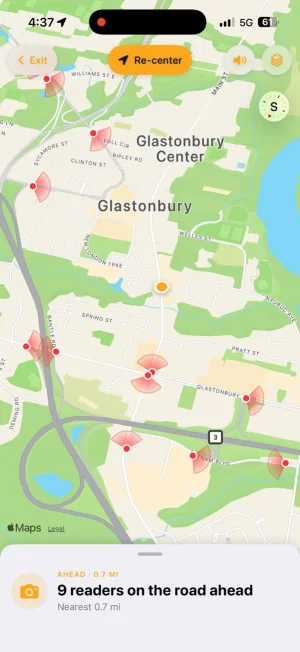
Flock Camera's map shows the operator for each mapped reader when it's recorded. Tap a pin for brand, operator and facing direction, or open Area Stats to see the top operators for whatever part of the map is on screen. That tells you which agency's policy to read, and where to send a public records request. To see the counts behind this table, the state pages break each state down by town.
Frequently asked questions
Which states have license plate reader laws?
Around 26, depending on what you count. The National Conference of State Legislatures lists statutes in Alabama, Arkansas, California, Colorado, Connecticut, Florida, Georgia, Idaho, Illinois, Iowa, Kentucky, Maine, Maryland, Minnesota, Montana, Nebraska, New Hampshire, New Jersey, New Mexico, North Carolina, Oregon, Tennessee, Utah, Vermont, Virginia and Washington.
Which state has the strictest ALPR law?
New Hampshire has the shortest retention: plates that don't match a hot list must be purged within 3 minutes. Virginia and Washington pair a 21-day limit with a closed list of allowed uses. Vermont goes furthest on paper, with a public-agency ban scheduled for July 2027.
Has any state banned Flock cameras?
No state bans them statewide. Florida's transportation department revoked permits for plate readers on state highway right-of-way in August 2026, and Texas paused state funding for Flock the same week. Local police in both states can still run cameras elsewhere.
How long can police keep license plate data in my state?
It depends on the state. Common limits are 21 days (Virginia, Washington, Connecticut, Maine), 30 days (Oregon, Iowa), 60 days (Minnesota) and 90 days (Kentucky, Tennessee, North Carolina, Montana). About half the states set no limit, so the agency's contract or policy decides.
Do I need a lawyer to use these laws?
Not to read them or to ask an agency what its policy is. Most of these statutes require a written policy and an audit log, which you can usually get through a public records request. For a stop, charge or lawsuit, talk to a lawyer licensed in your state.
Know before you pass one.
Flock Camera draws a view cone on every camera with a recorded bearing and warns you before you pass one. Free, with no account.

 Scan with your iPhone
Last reviewed 2026-10-16. Camera data © OpenStreetMap contributors (ODbL). Flock Camera is an independent project and is not affiliated with or endorsed by Flock Safety, Inc.