

What Flock says, and what the records show
Flock's position, set out on its own FAQ, is that it "does not work with" ICE and has no contract with it. Sharing with federal agencies is off by default, federal agencies were pulled out of the statewide and national lookup networks in August 2025, and since January 2026 an agency can switch off all federal sharing with one setting.
All of that can be true while ICE still gets answers from Flock cameras. The data belongs to the police department, sheriff or state agency that runs the cameras, and it can search any network that shares with it. If an officer at that agency runs a plate because ICE asked, ICE never touches Flock. That indirect route is what nearly every investigation on this topic has found.
So the honest answer to "does Flock share data with ICE" is: the company doesn't, by its account, but the agencies that own the data sometimes do, and whether that's legal depends on your state.
What audits and reporting have found
Most of what's known comes from search audit logs, which record who ran each search and the reason they typed. People get them through public records requests.
- May 2025, Illinois. Records from Danville showed more than 4,000 national and statewide lookups run by local and state police at the federal government's request or with a possible immigration focus, with reasons like "immigration" and "ICE" (404 Media). Danville officials denied their own officers ran immigration lookups.
- August 2025, Illinois. Secretary of State Alexi Giannoulias said a sample audit of 12 agencies found Customs and Border Protection had reached Illinois camera data, which he called a violation of state law. Flock's CEO said the company had "communicated poorly" and paused its federal pilots (NBC Chicago).
- April 2026, Florida. A January audit log showed Florida Fish and Wildlife Conservation Commission police ran 38 searches marked "immigration", each one reaching more than 5,000 Flock networks. Nearly 800 of its officers were enrolled for immigration work under the federal 287(g) program (404 Media).
- June 2026, California. A San Francisco police audit found 299 improper searches of its network over about a year, run by a regional intelligence center for federal and out-of-state agencies. SFPD said neither ICE nor DHS was identified as a requester (KTVU).
- August 2026, New York. Researchers at S.T.O.P. and LatinoJustice found officers in at least two New York towns logging searches as "ICE" or "Wanted by ICE" (StateScoop).
There's a second route that isn't a search at all. EFF found that Flock lets agencies check plates against the FBI's NCIC "Immigration Violator" list, which only ICE maintains. Two departments, in Blue Island, Illinois and Sparks, Nevada, had it switched on. Flock says the alert goes to the local agency, not ICE (EFF).
Flock's federal pilots
For a few months in 2025, two Homeland Security agencies could search Flock data themselves. Flock lists a Homeland Security Investigations pilot from March 3 to May 1, 2025, and a CBP pilot from May 9 to August 24, 2025, both now ended. Records from three police departments showed CBP had been searching across Flock's network during that time, and one of the departments said it hadn't known it was sharing with CBP (404 Media). Flock says it stopped running federal pilots that August.
Where state law forbids it
A handful of states stop police from passing plate data to immigration enforcement. These laws bind the agency that holds the data, not Flock.
| State | Rule | Source |
|---|---|---|
| California | Plate data may go only to another California public agency, so no federal or out-of-state sharing | Civ. Code 1798.90.55(b); 2023 AG bulletin |
| Illinois | No sharing for investigations based on immigration status; out-of-state agencies must sign a declaration first | Public Act 103-0540 (2023) |
| Washington | No use for immigration enforcement; sharing largely barred except when a court requires it | SB 6002, in force March 30, 2026 |
Colorado, Connecticut, New Mexico and Virginia have their own limits on immigration use or federal sharing, covered in our state-by-state table. In Virginia, Alexandria's mayor said in August 2026 that the city's police department "does not and will not share any of this data in civil immigration cases" (ALXnow). Where there's no state rule, the answer is whatever the local agency's policy and sharing list say.
Finding out who runs the cameras near you
The first step for any of this is knowing which agency owns the cameras on your streets, because its policy and its sharing list are what a records request asks for. Flock Camera's map shows the recorded operator when you tap a camera, and Area Stats lists the top operators for whatever part of the map is on screen. Some aren't local police at all: Customs and Border Protection is recorded as the operator of 85 mapped readers of its own.
The app can't tell you whether your plate was searched or who it went to. For that, see how to find out if police searched your plate, and who can access Flock data for how sharing works in general.
Frequently asked questions
Does ICE have direct access to Flock cameras?
Flock says no: it has no ICE contract, and since August 2025 federal agencies can't use its statewide or national lookup. A federal agency can still get a one-to-one share if a local agency grants it, and local officers can search on ICE's behalf.
Does my city share Flock data with ICE?
Ask your police department, and check whether it runs a Flock transparency portal. A public records request for the agency's sharing list and its search audit log will show which agencies can see its data and the reasons officers typed for each search.
Which states ban sharing license plate data with ICE?
California bars sharing with federal and out-of-state agencies at all. Illinois and Washington bar sharing or using the data for immigration enforcement. Colorado, Connecticut, New Mexico and Virginia have their own limits. Most other states have no immigration-specific rule.
Did Flock work with CBP or Homeland Security?
Yes, briefly. Flock lists a Homeland Security Investigations pilot from March 3 to May 1, 2025, and a Customs and Border Protection pilot from May 9 to August 24, 2025. It says it stopped all federal pilots in August 2025.
Does Flock's immigration filter stop these searches?
Only partly. An agency that turns it on can't run a search whose stated reason is immigration. But it's opt-in, and it can't catch a search for ICE logged under a vague reason like "investigation", which reporters have found in audit logs.
Know before you pass one.
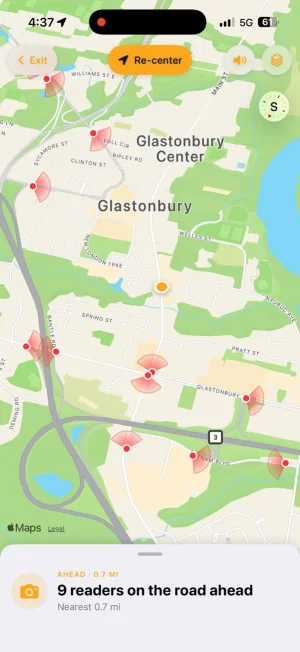
Flock Camera draws a view cone on every camera with a recorded bearing and warns you before you pass one. Free, with no account.

 Scan with your iPhone
Last reviewed 2026-10-21. Camera data © OpenStreetMap contributors (ODbL). Flock Camera is an independent project and is not affiliated with or endorsed by Flock Safety, Inc.