

Legal, with no state rules at all
Wisconsin has never passed a law about license plate readers. The National Conference of State Legislatures' statute tracker (updated September 28, 2026) lists "no statute identified" for the state. So there's no retention limit, no sharing rule and no audit requirement in state law. Whatever limits exist come from each agency's contract with Flock and its own policy. Our state-by-state table shows what those rules look like where they do exist.
That gap is why the fight in Wisconsin has moved to courtrooms and council chambers. Nobody has yet won a ruling that Flock searches are illegal here, and no court has ruled the other way in these cases either. Volunteers have mapped 2,113 plate readers in Wisconsin. That's what's been documented, not every camera that exists.
Two lawsuits want a warrant rule
Neither case asks a court to ban the cameras. Both ask that police get a warrant before searching where a car has been.
| Waukesha County case | ACLU of Wisconsin petition | |
|---|---|---|
| Filed | September 2026, in state court in Waukesha County | October 14, 2026, directly with the Wisconsin Supreme Court |
| Who's suing | No Cams Muskego, represented by the Wisconsin Institute for Law & Liberty | Wisconsin Council of Churches and a Green Bay pastor, represented by the ACLU of Wisconsin and EFF |
| Against | Nearly a dozen Waukesha County cities and villages | Milwaukee, Green Bay, Racine, Kenosha |
| Legal basis | Fourth Amendment (US Constitution) | Article I, Section 11 of the Wisconsin Constitution |
| Where it stands | Moved to federal court on October 7; defendants asked to pause it until the Seventh Circuit rules in a similar Illinois case | The court hasn't decided whether to take it |
Sources: Fox 6, ACLU of Wisconsin, WPR.
The state-constitution route matters. Most federal courts have held that photographing a plate on a public road isn't a search, and the Waukesha defendants' lawyer, Sam Hall, told Fox 6 a plate photo "doesn't invoke the Fourth Amendment." Flock told Fox 11 that more than 45 courts have found fixed plate readers don't violate it. The Wisconsin Supreme Court can read its own constitution more broadly, and it could rule without waiting for the federal appeals courts. Our guide to warrantless Flock searches covers the rulings elsewhere.
Who has dropped Flock, and why
Most Wisconsin exits weren't about warrants. They were about what Flock did with the data. In March a Flock sales rep offered Sheboygan's public works department five years of traffic volume and speed data the cameras had been collecting, according to Fox 6.
Agencies whose contracts promised 30-day deletion read that as a broken promise. "This is not what we agreed to, and it's not what the public was led to believe," the Racine County Sheriff's Office said. Flock has said "customers own and control their data and Flock does not sell it" (WPR).
- Racine County Sheriff's Office took its cameras down in early September. The City of Racine's police kept theirs and said they'd revisit the deal (CBS 58).
- Fond du Lac County: the sheriff and the Fond du Lac, North Fond du Lac, Waupun and Ripon police ended their agreements together on September 4 (Fox 6).
- Sheboygan's council voted unanimously on September 8 to end its contract for 15 cameras at year's end, keeping them covered until then (NBC 26).
- Stevens Point covered its 10 cameras and suspended use. "We really have no way of auditing where the Flock data goes," the mayor said (WPR).
- De Pere police cut off access in September. Its contract ends November 15 (Fox 11).
- Milwaukee County's board voted 16-0 on October 1 to remove all Flock cameras, plate readers included, from county parks. The sheriff's office opposed it, saying the cameras had helped solve violent crimes, and can replace them with conventional video cameras (Urban Milwaukee).
Plenty of agencies are staying. Milwaukee police said in October they plan to renew their contract, citing "investigative and public safety benefits," after several officers were found to have misused the system (Spectrum News). Green Bay kept its cameras under an updated policy (Fox 11). And moving off Flock doesn't always mean dropping plate readers: Kenosha, which put ending its Flock contract on its council agenda, has signed a 10-year deal with Axon for fixed-pole readers (Fox 6). Our list of cities that cancelled Flock tracks exits in other states.
What could change in 2027
- The Legislature. Rep. Calvin Callahan, who chairs the Assembly consumer protection committee, plans a hearing when lawmakers return in January and says the cameras shouldn't operate without warrants, judicial oversight and strict retention limits (Fox 11). We found no filed bill as of November 13.
- The attorney general. Josh Kaul, reelected on November 3, backs the technology but wants a state law, including limits on selling plate data to private companies. "I don't want to live in a surveillance state," he said (CBS 58).
- The new governor. David Crowley, elected November 3, pledged during the campaign to "implement strict transparency and accountability laws" (AP via Fox 11). As county executive he signed the parks removal.
- The courts. Whether the state Supreme Court takes the ACLU petition, and how the Seventh Circuit rules in the Illinois case.
Until then, the rules that apply to you are local. A public records request gets your police department's retention and sharing policy.
Seeing which Wisconsin cameras are near you
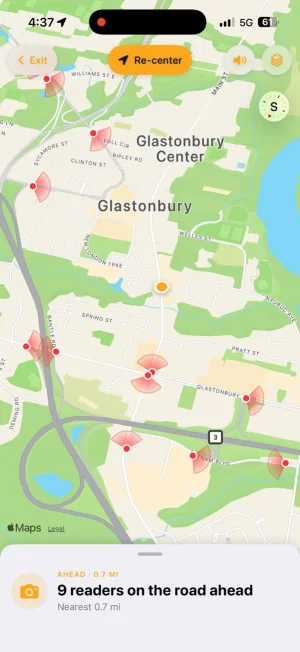
With every agency setting its own rules, it helps to know whose camera you're looking at. Tap a pin in Flock Camera to see its brand, operator and facing direction, where those are recorded. Area Stats totals the readers on screen and their top operators, so you can see whether your county leans on Flock or on another brand like Axon.
One caveat that matters in Wisconsin right now: the app maps known positions. It can't tell whether a camera has been covered or switched off, so a bagged Sheboygan camera still shows as a pin until someone updates OpenStreetMap and that data ships in an app update. Browse the Wisconsin page by city, or open the map.
Frequently asked questions
Does Wisconsin regulate license plate readers?
No. The National Conference of State Legislatures lists no ALPR statute for Wisconsin, so there's no state limit on how long agencies keep plate data or who they share it with. Each agency's contract and policy decide. Racine County, for example, required 30-day deletion in its own contract.
What is the Waukesha Flock lawsuit?
A residents' group, No Cams Muskego, represented by the Wisconsin Institute for Law & Liberty, sued nearly a dozen Waukesha County communities in September 2026. It argues warrantless searches of Flock data violate the Fourth Amendment. The defendants moved it to federal court and asked to pause it pending a Seventh Circuit ruling.
Is Wisconsin banning Flock?
Not as of November 2026. No ban or limit has passed the Legislature. Rep. Calvin Callahan plans a hearing when lawmakers return in January, Attorney General Josh Kaul wants a state law setting guardrails, and Governor-elect David Crowley has promised transparency and accountability laws.
Do Wisconsin police need a warrant to search Flock?
No law or court ruling requires one today. The ACLU of Wisconsin's petition asks the state Supreme Court to read the Wisconsin Constitution's search clause as requiring a warrant before police query plate data in Milwaukee, Green Bay, Racine and Kenosha. The court hasn't said whether it will hear the case.
Know before you pass one.
Flock Camera draws a view cone on every camera with a recorded bearing and warns you before you pass one. Free, with no account.

 Scan with your iPhone
Last reviewed 2026-11-13. Camera data © OpenStreetMap contributors (ODbL). Flock Camera is an independent project and is not affiliated with or endorsed by Flock Safety, Inc.